How the mole works2

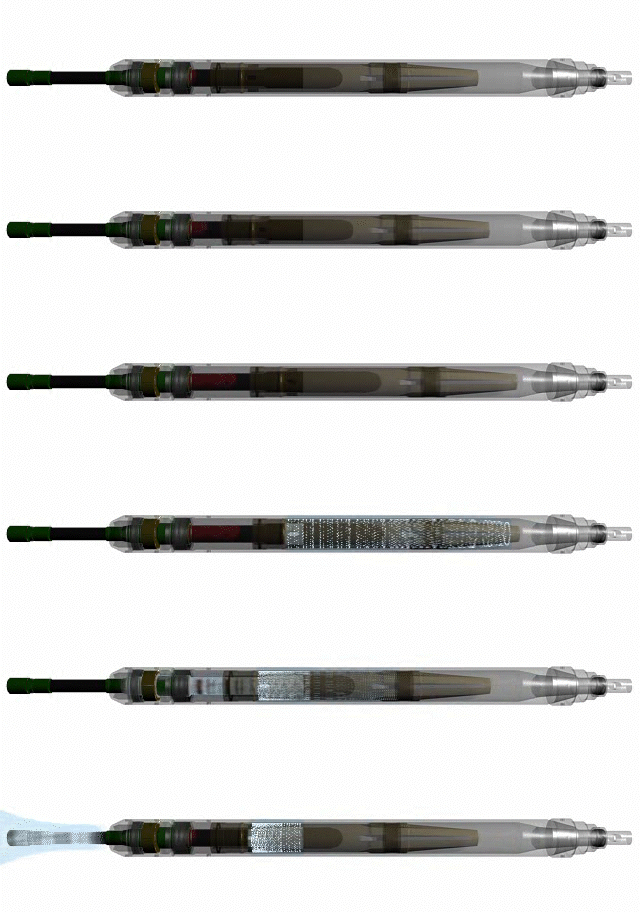
MAX Piercing Power trenchless technology tools belong to the category of pneumatic impact machines. Based on their application they can be divided into two main groups: moles and hammers. The easiest way to explain operation principles of such tools is to say that their construction is based on a reciprocating striker piston of high mass encased in a cylindrical housing made of high-tempered steel and powered by compressed air. The piston imparts its kinetic energy onto the head thereby moving the whole machine. The below animation shows the working principle of a pneumatic impact machine.
jak działa kret

Compressed air is supplied to the mole through a supply hose. The air moves the piston encased in a cylinder (housing). The piston hits the element of the mole’s head called the anvil, and at the same time the air starts pushing the piston backwards, preparing it for the next forward stroke on the head.

The backward movement is based on a similar principle, the only difference being the position of driver elements in a mole, shifted through the pneumatic valve controlling the direction of work. After changing the position of the driver element, the air entering the mole pushes the piston in the opposite direction, so that it does not hit the anvil, but the back part of the device, where the tail screw is located.

Depending on the size of the machine, the piston hits the head 4-6 times per second. Based on this information it is easy to estimate how many such cycles (hits) occurs during the machine service life. We can assume that one stroke causes a 0.5 cm linear progress along the axis of the borehole (in practice it depends on soil conditions), which gives us 4000 strokes needed for a 20 m tunnel. Some of the companies using our products make up to 100 m of boreholes per day, which adds up to 20 km per year and is a result of 4 million piston strokes.  And our tools have been used by some users even for up to 8 years.

It is worth mentioning that such impressive mileage is possible due to the use of Teflon guides and seals. These elements are worn in the first place, then they can be replaced at a very low cost, and after replacement the machine works for a long time like a new one, without air leaks or loss of efficiency. On the other hand moles without replaceable guides and seals require a scheduled overhaul after 5 km, as confirmed by one of their manufacturers*. The overhaul involves replacement of the used steel elements: the piston or/and the cylinder. This is a very expensive procedure, because these two components are the most important and the most expensive parts of the impact machine. Besides in machines without the Teflon seals the impact energy is gradually diminishing over the machine’s life cycle, due to increasing clearance between the piston and the housing.

The MAX series moles are capable of moving forward underground by means of displacing and compacting the soil, and equipped with the driver allowing remote pneumatic control over their work direction. They can be reversed during operation with a steering valve located on the control panel of the oiler – there is no need to stop the machine.

MAX rammers are tools for trenchless installation of steel pipes and other objects – with proper adapters. The standard set contains different diameter cones for inserting pipes. Some of the larger moles can be used for installing pipes as well, which makes them very versatile tools.

Pneumatic impact machines require a source of compressed air. We recommend the use of rotary screw compressors and the maximum working pressure of 7 atm.


History of the mole2

HISTORY OF THE MOLE IN THE WORLD

The history of the development of pneumatic ground penetrators known as "moles" dates back to World War I, when the idea arose to create a machine that would make it possible to dig under enemy fortifications from a safe distance and place an explosive charge inside.

In the 1950s, Wiktor Zienkiewicz, working in the Polish Ship Salvage Service, proposed using this type of machine to pull ropes under the bottom of a sunken ship and lift it from the bottom.

ilustracja

The event, although not successful, resonated so much that the construction of the mole and its improvement was taken up by Kazimierz Zygmunt and Tadeusz Gerlach of the Gdansk University of Technology. The design of the pneumatic soil piercer intended for pulling cables into the ground and driving steel pipes proved to be very successful and was transferred to mass production. The first mass-produced "moles," 4,000 in number, were made at the Gniezno Metal Works of the Territorial Industry and the Metal Works in Skarżysko. Most of the machines were exported mainly to the USA, Russia and Japan, where new design solutions for the mole began to be developed from the '60s and '70s. Particularly strong "competition" from Soviet solutions led, in the mid '70s, to the cessation of production in Poland.

The development of the "mole" in Poland only resumed in 1996 in Gdansk. It was undertaken by Terma Technologie, now TERMA, a company known very well in those days for the production of bathroom heaters and radiators. In cooperation with the "old" team from the Gdansk University of Technology, a prototype "mole" with a diameter of 130 mm was created after a year. Six more prototypes were made, which underwent tests on a dynamometer (indexing and strain gauge measurements) and field tests in conditions as intended. Several years of research and development made it possible to start production and sales of pneumatic-impact machines MAX Impact Power from the year 2000. Their performance characteristics made them worthy of standing up to machines produced by foreign manufacturers. MAX-type machines received numerous industry awards, setting completely new quality and functional standards in the market. "Moles" gained a new head mounting solution, higher-weight beaters, innovative use of reverse gear, which make them among the strongest and most innovative "moles" on the market.

HISTORY OF THE MOLE IN TERMA

Since 1990, TERMA (before known as TERMA TECHNOLOGIE), in addition to manufacturing radiators, has also been engaged in contract piercing, using machines offered from other manufacturers of pneumatic piercing machines. Hence the idea of producing its own moles and improving their design and functionality was born. Extensive experience in piercing installations meant that piercing machines of our own production quickly gained recognition in the market.

2000 - Mass production and sales of the MAX K130S. To date, it is still the most popular mole model in TERMA's product line.

    2002 - introduction of MAX K65

        2003 - introduction of MAX K75S

            2008 - introduction of MAX K180S

                2011 - introduction of MAX K95S

                    2013 - introduction of MAX K160S

                        2016 - introduction of MAX K55

                              2017 - introduction of MAX K75K  

Information on technological capabilities and machinery can be found HERE.

Information on individual products can be found HERE.

GALLERY

The history of the mole at the Gdansk Polytechnic University.

The materials are from the resources of the Department of Mechanical Engineering at Gdansk Polytechnic University and published with the permission of the department's staff.

The photos show a small section of the trials of the first mole designs developed at Gdansk Polytechnic University. On the basis of these trials, and others conducted in laboratory conditions, a team of employees of the Department of Fundamentals of Mechanical Engineering at Gdansk Polytechnic University developed a whole series of specific statements and conclusions, on the construction of effective and durable piercing machines. On the basis of these materials, TERMA undertook its own production of piercing machines.

ilustracja


 ilustracja


ilustracja


   ilustracja


ilustracja


ilustracja

ilustracja


ilustracja

ilustracja

THE MOLES NOW

The current offer of moles and accessories, is a response to inquiries and suggestions from customers-users. The constantly changing expectations of users make our offer constantly developed with new models of machines and accessories.

ilustracja

ilustracja

ilustracja